Have you ever wondered why governments and regulated industries are increasingly demanding cloud solutions that keep data under national or regional control?
In 2025, the Sovereign Cloud market is no longer a niche concern but an accelerating global trend, expected to hit USD 143.32 billion by year’s end—driven by growing regulatory pressure to ensure sensitive data remains within jurisdictional boundaries. Let’s dive into the forces shaping the future of cloud computing—one that prioritizes data sovereignty.
According to the market analysis by Next Move Strategy Consulting, which considers public, private, and hybrid sovereign cloud deployments, the global Sovereign Cloud Market is expected to be valued at USD 143.32 billion by the end of 2025. The industry is projected to grow, hitting USD 479.12 billion by 2030, with a CAGR of 27.3%.
What is Sovereign Cloud? Understanding the Key Principles
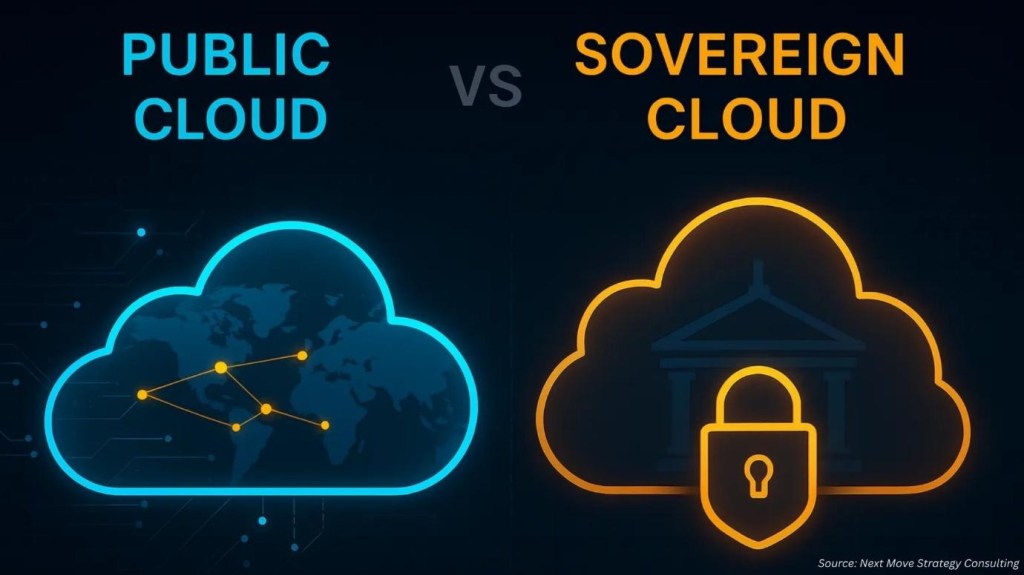
A sovereign cloud provides infrastructure where data residency, operational control, and governance remain within specific geographic or jurisdictional boundaries. This approach helps organizations meet stringent regulations on data protection and reduces risks from foreign legal access.
Key characteristics include:
- Strict data and metadata residency
- Operations managed by local personnel
- Technical and logical separation from global clouds
- Independent governance structures
These elements empower public sector organizations and highly regulated industries with greater control over their data and operations.
How Is AWS Advancing European Sovereign Cloud Capabilities?
In December 2025, AWS released the European Sovereign Cloud Sovereign Reference Framework (ESC-SRF), detailing how the upcoming AWS European Sovereign Cloud meets sovereignty criteria across governance, operations, data residency, and isolation.
The framework includes:
- Operations exclusively by EU-resident personnel
- Strict residency for customer data and metadata
- Separation from other AWS Regions
- Third-party audit planned for 2026
The cloud, set to launch its first Region in Germany by the end of 2025, builds on prior investments and aims to provide full AWS capabilities with enhanced sovereignty assurances.
Next Move Strategy Consulting observes that this transparent framework has the potential to reduce compliance burdens for European customers by offering verifiable controls that align with EU expectations, although large-scale adoption will depend on successful audits and operational execution.
Why Is Microsoft Investing Heavily in India’s Sovereign Cloud?
On December 10, 2025, Microsoft announced a $17.5 billion investment in India over the next four years, the company’s largest in Asia, focused on sovereign-ready hyperscale infrastructure.
Highlights include:
- Expansion of data centers in Hyderabad (to be operational by mid-2026), Pune, and Chennai
- Introduction of Sovereign Public Cloud and Sovereign Private Cloud options
- Localized data processing for tools like Copilot
- Partnerships with Indian firms for private cloud delivery
This builds on an earlier $3 billion commitment in 2025, responding to evolving data privacy requirements.
From Next Move Strategy Consulting’s perspective, this investment underscores India’s emerging role in the sovereign cloud landscape, driven by rising AI workloads and evolving data protection regulations. It also intensifies competition among hyperscalers, which may spur further infrastructure development while giving organizations more options for compliant AI deployment.
What Does the SUSE and Evroc Alliance Mean for European Sovereignty?
SUSE and evroc announced a partnership in 2025 to deliver Kubernetes-based sovereign cloud solutions in Europe, compliant with the EuroStack framework.
The offering features:
- SUSE Rancher Prime for Kubernetes management
- Hosting in Europe with support from European personnel
- Focus on reducing dependence on non-European vendors
- Planned launch in the first quarter of 2026
This alliance emphasizes open-source infrastructure for secure, regional control.
This collaboration represents a strategic step toward diversifying the European sovereign cloud market beyond reliance on U.S.-based hyperscalers. It promotes interoperable, vendor-independent options, which could lower barriers for enterprises prioritizing digital autonomy and potentially fragment the market into more localized ecosystems.
How Are These Developments Impacting the Sovereign Cloud Market?
As the sovereign cloud market continues to surge, the opportunities for organizations to leverage more control over their data have never been greater. The investments by AWS, Microsoft, and SUSE/evroc signal a seismic shift in how cloud infrastructure is being designed, offering unprecedented potential for growth and compliance. AWS provides structured assurances for Europe, Microsoft drives massive investment in Asia’s largest market, and SUSE-evroc advances open-source European options.
As Next Move Strategy Consulting analysts note, such moves reflect rising demand for sovereignty amid geopolitical and regulatory pressures. They encourage hyperscalers to innovate on controls while opening doors for regional players, ultimately expanding market opportunities for compliant cloud adoption.
Key impacts:
- Increased investment in localized infrastructure
- Greater competition and diversified offerings
- Accelerated compliance for regulated sectors
Next Steps: Actionable Takeaways for Stakeholders
To stay ahead of the curve in this rapidly evolving market, businesses should:
- Assess your current cloud infrastructure to determine whether it aligns with local data residency requirements.
- Explore sovereign cloud offerings like AWS ESC, Microsoft’s Sovereign Cloud, or independent open-source solutions to ensure compliance.
- Stay updated on 2026 launches and audits for compliance certifications and sovereignty guarantees.
- Engage in sovereignty gap analysis to ensure your current strategies align with upcoming regulations.
- Prioritize training in sovereign cloud architectures to smoothly transition and support cloud migrations.
These steps position businesses and governments to leverage the evolving sovereign cloud market effectively.
With significant investments and architectural innovations reshaping cloud infrastructure, 2025 is emerging as a pivotal year for organizations seeking to safeguard data sovereignty and regulatory compliance. As compliance becomes more complex and data protection more crucial, sovereign cloud solutions will be the cornerstone of digital transformation for regulated industries across the globe.
About the Author

Sneha Chakraborty is a passionate SEO Executive and Content Writer with over 4 years of experience in digital marketing and content strategy. She excels in creating optimized, engaging content that enhances online visibility and audience engagement. Skilled in keyword research, analytics, and SEO tools, Sneha blends creativity with data-driven insights to deliver impactful results. Beyond her professional work, she enjoys reading, sketching, and nature photography, drawing inspiration from creativity and storytelling. The author could be reached out at info@nextmsc.com.
 Devtrix
Leave a comment